

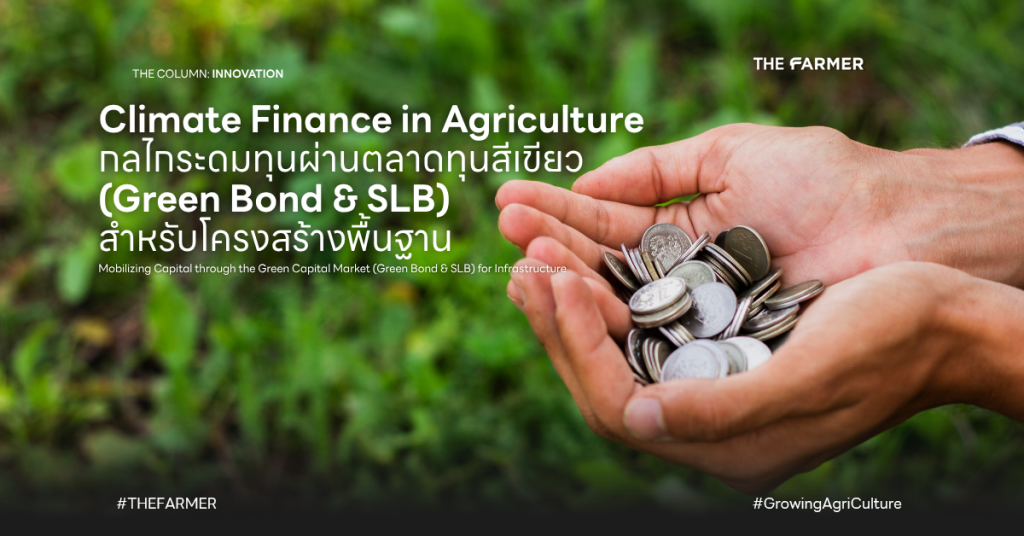
THE COLUMN: Climate Finance in Agriculture กลไกระดมทุนผ่านตลาดทุนสีเขียว (Green Bond & SLB) สำหรับโครงสร้างพื้นฐาน
THE COLUMN: Climate Finance in Agriculture – Mobilizing Capital through the Green Capital Market (Green Bond & SLB) for Infrastructure
⸻
(English is below)
⸻
“เมื่อความยั่งยืนไม่ได้ถูกวัดค่าแค่บนหน้ากระดาษรายงาน CSR แต่คือ ‘กุญแจ’ ที่ใช้เปิดประตูสู่ฐานทุนใหม่และเพิ่มโอกาสลดต้นทุนทางการเงิน การระดมทุนผ่านตลาดทุนสีเขียวจึงเป็นยุทธศาสตร์สำคัญที่จะดึงเม็ดเงินมาพลิกโฉมโครงสร้างพื้นฐานการเกษตรและทรัพยากรไทย”
การปรับตัวรับมือกับการเปลี่ยนแปลงสภาพภูมิอากาศ (Climate Change) ไม่สามารถทำได้ด้วยเงินทอนจากงบ CSR โปรเจกต์ระดับโครงสร้างพื้นฐาน (Infrastructure) สำหรับอนาคตการเกษตร เช่น ระบบบริหารจัดการน้ำอัจฉริยะ (Smart Water Grid) ระดับภูมิภาค หรือศูนย์วิจัยสถาปัตยกรรมจีโนมิกส์สำหรับพืชทนแล้ง ล้วนต้องการเม็ดเงินลงทุน (CAPEX) มหาศาลและสายป่านที่ยาวพอ
แต่ปัญหาคอขวดที่อุตสาหกรรมไทยต้องเผชิญคือ การขาดแคลนแหล่งเงินทุน สาเหตุหลักมาจากสถาบันการเงินดั้งเดิม (Traditional Banks) มักใช้ “การประเมินความเสี่ยงแบบเก่า” ที่มองหาแต่หลักทรัพย์ค้ำประกันและผลตอบแทนระยะสั้น (Short-term ROI) ทำให้โครงการปรับตัวด้านสภาพอากาศที่ต้องใช้เวลาคืนทุนนาน ถูกปัดตก หรือถูกมองว่ามีความเสี่ยงสูง การก้าวข้ามกับดักนี้จึงต้องพึ่งพาสถาปัตยกรรมทางการเงินยุคใหม่ที่เรียกว่า Climate Finance
อย่างไรก็ตาม ต้องยอมรับว่าเครื่องมือทางการเงินเหล่านี้ถูกออกแบบมาสำหรับ บริษัทมหาชนหรือกลุ่มทุนการเกษตรขนาดใหญ่ ที่มีเครดิตเรตติ้งระดับสถาบัน สำหรับผู้ประกอบการ SME หรือเกษตรกรรายย่อย การเข้าถึงเม็ดเงินเหล่านี้มักจะเกิดขึ้นในลักษณะ ‘ผลกระทบเชิงบวกผ่านห่วงโซ่อุปทาน (Supply Chain Cascade)’ เมื่อบริษัทใหญ่ลงทุนโครงสร้างพื้นฐานสำเร็จ หรือต้องพึ่งพากลไกคู่ขนานอื่น เช่น สินเชื่อแบบผสมผสาน (Blended Finance)

⸻
The Financial Instruments: บทเรียนข้ามอุตสาหกรรมสู่อนาคตเกษตรไทย
แม้ปัจจุบันโปรเจกต์ด้านการเกษตรโดยตรงที่ออกตราสารเหล่านี้ระดับหมื่นล้านอาจยังมีจำกัด แต่การเรียนรู้จาก ‘บทเรียนข้ามอุตสาหกรรม (Cross-industry Lessons)’ จากภาคพลังงานและประมง คือพิมพ์เขียวสำคัญที่กลุ่มทุนเกษตรต้องนำมาปรับใช้ ในโลกของตลาดทุนสีเขียว “ความยั่งยืน” มีค่าเท่ากับ “เครดิต” ผ่าน 2 กลไกหลัก:
- Green Bond (ตราสารหนี้เพื่ออนุรักษ์สิ่งแวดล้อม): คือการออกพันธบัตรหรือหุ้นกู้ที่ “ล็อกเป้าหมาย” ชัดเจนว่าเม็ดเงินที่ระดมได้จะต้องถูกนำไปใช้ในโปรเจกต์สีเขียวเท่านั้น (Use of Proceeds) เช่น โครงสร้างพื้นฐานด้านการจัดการน้ำ หรือโรงไฟฟ้าพลังงานหมุนเวียน ข้อดีคือตราสารประเภทนี้เป็นที่ต้องการอย่างมากจากกองทุนระดับโลก ทำให้ระดมทุนได้เร็วและ อาจ ได้ต้นทุนที่ถูกกว่าหุ้นกู้ปกติ (Greenium)
- พิมพ์เขียวโครงสร้างพื้นฐาน: บริษัท ซีเค พาวเวอร์ จำกัด (มหาชน) หรือ CKPower และ ไซยะบุรี พาวเวอร์ (XPCL) ประสบความสำเร็จในการออก Green Bond มูลค่ารวมกว่า 2 หมื่นล้านบาท เพื่อใช้ในโครงการโครงสร้างพื้นฐานด้านพลังงานน้ำ (Hydroelectric) หุ้นกู้ชุดนี้ได้รับความสนใจจน “มียอดจองล้น (Oversubscribed)” สะท้อนว่าตลาดทุนพร้อมเทเม็ดเงินจำนวนมหาศาลให้กับโปรเจกต์ขนาดใหญ่ที่เป็นมิตรต่อสิ่งแวดล้อม
- Sustainability-Linked Loan (SLL) และ Bonds (SLB): นวัตกรรมทางการเงินที่ไม่ได้ล็อกว่าต้องนำเงินไปทำโปรเจกต์อะไร แต่จะ “ผูกอัตราดอกเบี้ยเข้ากับเป้าหมายความยั่งยืน (SPTs – Sustainability Performance Targets)” หากองค์กรทำได้ตามเป้า อัตราดอกเบี้ยเงินกู้จะปรับ “ลดลง” (Step-down Margin)
- พิมพ์เขียวอุตสาหกรรมอาหาร: บริษัท ไทยยูเนี่ยน กรุ๊ป จำกัด (มหาชน) หรือ TU เป็นองค์กรแรกในไทยที่ออก SLL (ก.พ. 2564) และ SLB ที่มีกลไก Step-up/Step-down (ก.ค. 2564) โดยผูกอัตราดอกเบี้ยเข้ากับเป้าหมาย 3 ประการ ได้แก่:
1. การรักษาอันดับใน DJSI
2. การลดความเข้มข้นของการปล่อยก๊าซเรือนกระจก (Scope 1 & 2) 4% ต่อปี 3. การเพิ่มการตรวจสอบกองเรือประมงทูน่า
- พิมพ์เขียวอุตสาหกรรมอาหาร: บริษัท ไทยยูเนี่ยน กรุ๊ป จำกัด (มหาชน) หรือ TU เป็นองค์กรแรกในไทยที่ออก SLL (ก.พ. 2564) และ SLB ที่มีกลไก Step-up/Step-down (ก.ค. 2564) โดยผูกอัตราดอกเบี้ยเข้ากับเป้าหมาย 3 ประการ ได้แก่:

⸻
Thailand’s Capital Ecosystem & The Greenwashing Risk
การจะดึงดูดเม็ดเงินระดับสากลได้ ตลาดทุนต้องโปร่งใส ปัจจุบันประเทศไทยมีระบบนิเวศรองรับ นำโดย ก.ล.ต. ที่ยกเว้นค่าธรรมเนียมการยื่นคำขออนุญาตสำหรับการออก Green Bond เพื่อลดต้นทุน และ ThaiBMA ที่ทำหน้าที่เป็นศูนย์กลางข้อมูล (ESG Bond Information Platform)
อย่างไรก็ตาม เหรียญย่อมมีสองด้าน: ความท้าทายสำคัญที่นักลงทุนสถาบันจับตามองอย่างหนักคือ ความเสี่ยงจากการฟอกเขียว (Greenwashing) แม้แต่องค์กรระดับผู้บุกเบิกในตลาดก็ยังเคยเผชิญกับการตั้งคำถามจากนักวิเคราะห์ ESG ถึงระดับความท้าทายของเป้าหมาย (SPTs) ว่าเข้มข้นพอหรือไม่ หรือเป็นเป้าหมายที่บริษัทแทบจะบรรลุไปแล้วก่อนออกตราสารด้วยซ้ำ บทเรียนนี้ชี้ให้เห็นว่า การตั้งเป้าหมายใน SLB ต้องท้าทายและสร้างผลกระทบจริง (Ambitious and Material) หากเป้าหมายอ่อนแอเกินไป ตราสารนั้นอาจถูกนักลงทุนตั้งข้อกังขา และส่งผลเสียต่อชื่อเสียงขององค์กรในระยะยาว

⸻
Regenerate: Farm to Future
ยุคที่ ESG เป็นเพียงเครื่องมือประชาสัมพันธ์ได้จบลงแล้ว วันนี้ความยั่งยืนคือ “กลยุทธ์ทางการเงิน” ที่ทรงประสิทธิภาพ
องค์กรของคุณจะยอมปิดกั้นตัวเองอยู่กับตลาดสินเชื่อแบบดั้งเดิมต่อไปทำไม? ในเมื่อผลงานด้านการจัดการของเสีย การบริหารน้ำ และการลดคาร์บอนฟุตพรินต์ สามารถแปรสภาพเป็น ‘เครดิตชั้นดี’ ที่ใช้ดึงดูดเม็ดเงินจาก Sovereign Wealth Fund ทั่วโลกได้ การก้าวเข้าสู่ตลาด Climate Finance จึงไม่ใช่แค่ทางเลือก แต่คือโอกาสสำคัญในการขยายฐานนักลงทุนและ ‘เพิ่มโอกาส’ ในการลดต้นทุนถัวเฉลี่ยถ่วงน้ำหนักของเงินทุน (WACC) เพื่อสร้างการเติบโตอย่างยั่งยืนแบบไร้ขีดจำกัด
⸻
“When sustainability is no longer merely measured on the pages of CSR reports but acts as the “key” to unlocking new capital bases and increasing opportunities to reduce financial costs, fundraising through the green capital market becomes a crucial strategy to attract investments that will revolutionize Thailand’s agricultural and resource infrastructure.”
Adapting to Climate Change cannot be achieved using the spare change from CSR budgets. Infrastructure-level projects for the future of agriculture—such as regional Smart Water Grids or genomic architecture research centers for drought-resistant crops—all require massive Capital Expenditure (CAPEX) and a sufficient financial runway.
However, the bottleneck facing the Thai industry is the scarcity of funding sources. The primary cause is that Traditional Banks typically employ “outdated risk assessments” that solely look for collateral and Short-term ROI. Consequently, climate adaptation projects, which require long payback periods, are rejected or perceived as high risk. Overcoming this trap necessitates relying on a modern financial architecture known as Climate Finance.
Nevertheless, it must be acknowledged that these financial instruments are designed for public companies or large-scale agricultural conglomerates possessing institutional-grade credit ratings. For SME entrepreneurs or smallholder farmers, access to these funds usually occurs in the form of a “Supply Chain Cascade” (positive impact cascading through the supply chain) once major corporations successfully invest in infrastructure, or by relying on other parallel mechanisms like Blended Finance.
⸻
The Financial Instruments: Cross-Industry Lessons for the Future of Thai Agriculture
Although direct agricultural projects issuing these multi-billion-baht instruments may currently be limited, learning from “Cross-industry Lessons” from the energy and fishery sectors serves as a vital blueprint that agricultural conglomerates must adapt. In the world of green capital markets, “sustainability” equates to “credit” through two main mechanisms:
- Green Bond: This involves issuing bonds or debentures that clearly “lock in the target,” mandating that the mobilized funds must strictly be utilized for green projects (Use of Proceeds)—such as water management infrastructure or renewable energy power plants. The advantage is that this type of instrument is highly sought after by global funds, enabling faster fundraising and potentially securing cheaper costs than regular bonds (Greenium).
- Infrastructure Blueprint: CK Power Public Company Limited (CKPower) and Xayaburi Power Company Limited (XPCL) successfully issued Green Bonds totaling over 20 billion baht for hydroelectric energy infrastructure projects. These bonds garnered so much interest that they were “Oversubscribed,” reflecting the capital market’s readiness to pour massive amounts of funds into large-scale, environmentally friendly projects.
- Sustainability-Linked Loan (SLL) and Bonds (SLB): A financial innovation that does not restrict what projects the funds must be used for, but instead “ties the interest rate to sustainability goals (SPTs – Sustainability Performance Targets).” If the organization achieves its targets, the loan interest rate will be “adjusted downward” (Step-down Margin).
- Food Industry Blueprint: Thai Union Group PCL (TU) was the first organization in Thailand to issue an SLL (Feb 2021) and an SLB with a Step-up/Step-down mechanism (Jul 2021). The interest rates were tied to three specific targets:
1. Maintaining its ranking in the DJSI;
2. Reducing greenhouse gas emission intensity (Scope 1 & 2) by 4% annually 3. Increasing the monitoring of its tuna fishing fleet.
- Food Industry Blueprint: Thai Union Group PCL (TU) was the first organization in Thailand to issue an SLL (Feb 2021) and an SLB with a Step-up/Step-down mechanism (Jul 2021). The interest rates were tied to three specific targets:
⸻
Thailand’s Capital Ecosystem & The Greenwashing Risk
To attract international capital, the capital market must be transparent. Currently, Thailand possesses a supporting ecosystem spearheaded by the Securities and Exchange Commission (SEC), which waives the application fees for issuing Green Bonds to reduce costs, and the Thai Bond Market Association (ThaiBMA), which acts as the ESG Bond Information Platform.
However, every coin has two sides. A major challenge that institutional investors are heavily monitoring is the risk of Greenwashing. Even pioneer organizations in the market have faced scrutiny from ESG analysts questioning whether the difficulty level of their targets (SPTs) is rigorous enough, or if they are targets the company had practically achieved even before issuing the instrument. This lesson indicates that setting targets in an SLB must be genuinely challenging and impactful (Ambitious and Material). If the targets are too weak, the instrument may be questioned by investors, causing long-term damage to the organization’s reputation.
⸻
Regenerate: Farm to Future
The era where ESG was merely a public relations tool has ended. Today, sustainability is a highly potent “financial strategy.”
Why would your organization allow itself to remain confined within the traditional credit market? When achievements in waste management, water administration, and carbon footprint reduction can be transformed into “prime credit” utilized to attract capital from Sovereign Wealth Funds worldwide. Stepping into the Climate Finance market is not just an option; it is a crucial opportunity to expand the investor base and “increase opportunities” to reduce the Weighted Average Cost of Capital (WACC), forging limitless sustainable growth.
⸻
𝗧𝗛𝗘 𝗙𝗔𝗥𝗠𝗘𝗥: 𝗴𝗿𝗼𝘄𝗶𝗻𝗴 ◦ 𝗮𝗴𝗿𝗶 ◦ 𝗰𝘂𝗹𝘁𝘂𝗿𝗲 | 𝘙𝘦𝘨𝘦𝘯𝘦𝘳𝘢𝘵𝘪𝘷𝘦 𝘙𝘪𝘴𝘦
Facebook: https://www.facebook.com/thefarmer.th
YouTube: https://www.youtube.com/@thefarmerth
Instagram: https://www.instagram.com/thefarmerthai/

