

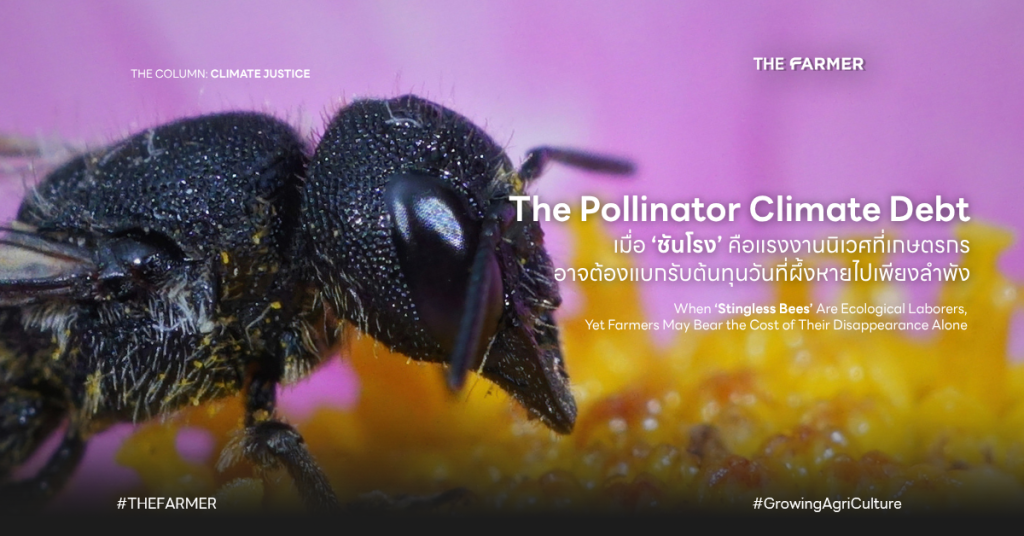
THE COLUMN: The Pollinator Climate Debt เมื่อ ‘ชันโรง’ คือแรงงานนิเวศที่เกษตรกรอาจต้องแบกรับต้นทุนวันที่ผึ้งหายไปเพียงลำพัง
THE COLUMN: The Pollinator Climate Debt — When ‘Stingless Bees’ Are Ecological Laborers, Yet Farmers May Bear the Cost of Their Disappearance Alone
⸻
(English is below)
⸻
“ในสวนผลไม้ไทย ผู้ช่วยที่มีค่าที่สุดอาจไม่ใช่เทคโนโลยีราคาแพง แต่คือแมลงตัวจิ๋วอย่าง ‘ชันโรง’ ทว่าเมื่อความร้อนสุดขั้วและความท้าทายในการจัดการศัตรูพืชกำลังคุกคามผู้ช่วยตัวน้อยเหล่านี้ คำถามสำคัญจึงไม่ใช่การหาว่าใครคือผู้ร้าย แต่คือเราจะร่วมกันดูแล ‘โครงสร้างพื้นฐานที่มีชีวิต’ นี้อย่างไร เพื่อไม่ให้ชาวสวนต้นน้ำต้องแบกรับต้นทุนการฟื้นฟูนิเวศไว้เพียงลำพัง”
⸻
จุดบอดของสมการ ESG เมื่อ ‘โครงสร้างพื้นฐานที่มีชีวิต’ ไม่อยู่ในระบบบัญชี
เมื่อพูดถึงความยั่งยืนในภาคเกษตรและอาหาร (ESG) สังคมมักโฟกัสที่ตัวชี้วัดสิ่งแวดล้อม (E) อย่างคาร์บอนฟุตพริ้นท์หรือเทคโนโลยีขั้นสูง จนบางครั้งมองข้ามกลไกชีวภาพขนาดเล็กที่เป็นรากฐานของผลผลิตจริงอย่าง “ชันโรง” (Stingless Bees) ผึ้งไร้เหล็กในที่มีบทบาทสำคัญในการผสมเกสรไม้ผลเศรษฐกิจ เช่น มะม่วง ลำไย และเงาะ ทั้งยังสร้างรายได้เสริมจากน้ำผึ้งชันโรงที่มีรสหวานอมเปรี้ยวและมีมูลค่าสูงในตลาดเฉพาะกลุ่ม
การทำความเข้าใจปัญหานี้ต้องมาทำความรู้จักคำศัพท์หลักสามคำ ประการแรกคือ บริการทางนิเวศจากการผสมเกสร (Pollination Ecosystem Services) หรือคุณค่าที่แมลงช่วยถ่ายทอดละอองเกสรจนเพิ่มโอกาสติดผล ซึ่งประสิทธิภาพจริงย่อมขึ้นอยู่กับชนิดของชันโรง ชนิดพืช และสภาพพื้นที่ ประการที่สองคือ หนี้ทางนิเวศจากสภาพภูมิอากาศ (Pollinator Climate Debt) ซึ่งใช้ในเชิงเปรียบเทียบเพื่ออธิบายภาระต้นทุนแฝงที่เพิ่มขึ้นเมื่อภาวะโลกร้อนทำให้แมลงผสมเกสรลดลง ไม่ใช่ภาระหนี้ตามกฎหมาย และประการสุดท้ายคือ การจัดการระดับภูมิทัศน์ (Landscape-level Management) หรือการบริหารจัดการสภาพแวดล้อมที่ต้องอาศัยความร่วมมือข้ามพรมแดนของแปลงเกษตรเดี่ยว
จุดบอดสำคัญของสมการ ESG ปัจจุบัน คือการแยกเรื่องความหลากหลายทางชีวภาพออกจากมิติสังคม (S) และการกำกับดูแล (G) ที่ผ่านมา ตลาดปลายน้ำต่างได้ประโยชน์จากผลไม้คุณภาพดีที่มีแมลงผสมเกสรช่วยสนับสนุน แต่เมื่ออุณหภูมิที่สูงขึ้นทำให้การดูแลชันโรงยากและมีต้นทุนสูงขึ้น ภาระกลับตกอยู่ที่ชาวสวนต้นน้ำ โดยที่โครงสร้างราคารับซื้อผลไม้ทั่วไปอาจยังไม่ได้สะท้อนต้นทุนการดูแลนิเวศเหล่านี้
⸻
ถอดรหัส 3 กลไกต้นทุนแฝงเบื้องหลังการพึ่งพาแมลงผสมเกสร
1. The Invisible Ecological Subsidy (เงินอุดหนุนทางนิเวศที่มองไม่เห็นในระบบบัญชี)
ระบบบัญชีเกษตรแบบดั้งเดิมมักคิดต้นทุนเฉพาะสิ่งที่มีใบเสร็จ เช่น ค่าปุ๋ย ค่ายา และค่าแรง ในขณะที่การผสมเกสรของชันโรงถูกมองว่าเป็นของฟรีจากธรรมชาติ ทั้งที่ในความเป็นจริง การรักษาประชากรชันโรงให้แข็งแรงต้องอาศัยการลงทุนดูแลรัง การปลูกพืชดอกหลากหลายเพื่อเป็นแหล่งอาหาร และการลดหรือยุติการใช้สารบางประเภทตามความเหมาะสมของสวน เมื่อตลาดรับซื้อผลไม้ไม่ได้ให้คุณค่าเพิ่มกับกระบวนการเหล่านี้ เกษตรกรจึงต้องแบกรับต้นทุนการดูแลฐานทรัพยากรไว้เอง
2. The Thermal & Chemical Squeeze (ความเปราะบางต่อความร้อนและโจทย์สารเคมีข้ามพรมแดน)
แมลงผสมเกสรไม่ได้รับรู้ถึงแนวรั้วที่ดิน ชาวสวนผู้เลี้ยงชันโรงจึงต้องเผชิญแรงบีบคั้นสองด้าน ด้านแรกคือคลื่นความร้อนที่อาจลดเวลาออกหาอาหารของแมลงหรือทำให้รังล่มสลาย ด้านที่สองคือการปกป้องผึ้งจากสารเคมีจากพื้นที่ใกล้เคียง ในความเป็นจริง เกษตรกรแต่ละรายเผชิญความเสี่ยงจากศัตรูพืชและข้อจำกัดด้านทุนไม่เท่ากัน การใช้สารเคมีของบางแปลงจึงเป็นความพยายามรักษาผลผลิตเพื่อความอยู่รอด ไม่ใช่ความตั้งใจทำลายสิ่งแวดล้อม ทว่าการขาดกลไกการคุยกันภายในพื้นที่อาจทำให้ละอองสารพัดข้ามแปลง ส่งผลให้ผู้เลี้ยงชันโรงสูญเสียแมลงโดยไม่อาจควบคุมปัจจัยภายนอกได้ลำพัง
3. The Labor & Opportunity Cost Gap (ช่องว่างต้นทุนแรงงานทดแทนและค่าเสียโอกาส)
เมื่อแมลงผสมเกสรลดลง ภาระทางนิเวศจะถูกแปลงเป็นภาระทางเศรษฐกิจของชาวสวนทันที ในบางระบบการจัดการที่การติดผลตามธรรมชาติลดลง ชาวสวนอาจต้องใช้แรงงานคนเดินช่วยผสมเกสรด้วยมือมากขึ้นท่ามกลางอากาศร้อนจัด ก่อให้เกิดทั้ง ต้นทุนทางเศรษฐกิจ จากค่าจ้างที่เพิ่มขึ้นหรือผลผลิตที่ลดลง และ ค่าเสียโอกาส ที่ครัวเรือนต้องเสียเวลาจากการพัฒนาสวนด้านอื่น รวมถึงสูญเสียโอกาสทำรายได้เสริมจากน้ำผึ้งชันโรง ซึ่งในบางบริบท เกษตรกรรายย่อยก็ยังติดข้อจำกัดด้านการจัดการความชื้นและเกณฑ์มาตรฐานสินค้าที่มักออกแบบมาเพื่อน้ำผึ้งอุตสาหกรรมทั่วไปมากกว่าน้ำผึ้งชันโรงธรรมชาติ

⸻
Evidence & Context: หลักฐานระดับโลกสู่บริบทท้องถิ่น
ความสำคัญและความเปราะบางของแมลงผสมเกสรได้รับการยืนยันในระดับสากล โดยข้อมูลสรุปของ IPBES (Intergovernmental Science-Policy Platform on Biodiversity and Ecosystem Services) ในรายงานเชิงกรอบด้านการประเมินแมลงผสมเกสรและการผลิตอาหาร ระบุว่ากว่าสามในสี่ของชนิดพืชอาหารสำคัญของโลกต้องพึ่งพาการผสมเกสรจากสัตว์และแมลงไม่มากก็น้อย และชี้ว่าแมลงผสมเกสรพื้นเมือง รวมถึงผึ้งไร้เหล็กในเขตร้อน กำลังถูกคุกคามจากการเปลี่ยนการใช้ที่ดิน สารเคมีบางประเภท และสภาพภูมิอากาศที่แปรปรวน สอดคล้องกับกรอบข้อมูลของ องค์การอาหารและการเกษตรแห่งสหประชาชาติ (FAO) ที่ระบุว่าแมลงผสมเกสรมีผลโดยตรงต่อทั้งปริมาณ คุณภาพ รูปลักษณ์ผลผลิต และรายได้เสริมของชุมชนชนบท จากกรอบดังกล่าว จึงสะท้อนว่าความเสื่อมโทรมของแมลงผสมเกสรจะส่งผลกระทบต่อเนื่องถึงเสถียรภาพของห่วงโซ่อาหารทั้งหมด
สำหรับบริบทที่อาจพบในประเทศไทย ชาวสวนไม้ผลเศรษฐกิจอย่างมะม่วง ลำไย และเงาะ เริ่มนำชันโรงมาช่วยเพิ่มโอกาสติดผลควบคู่กับการเก็บน้ำผึ้งขายเป็นรายได้เสริมมากขึ้น อย่างไรก็ตาม ในบางพื้นที่ เกษตรกรอาจเผชิญกับอากาศที่ร้อนและแล้งยาวนานขึ้นซึ่งกระทบต่อความอยู่รอดของรัง รวมถึงลักษณะสวนไทยที่มักเป็นแปลงย่อยติดกัน ทำให้การจัดการเวลาพ่นสารเคมีให้สอดคล้องกันทั้งชุมชนทำได้ไม่ง่ายนัก ขณะที่การขายน้ำผึ้งชันโรงของรายย่อยบางส่วนยังขาดการเข้าถึงมาตรฐานที่รองรับความชื้นและรสเปรี้ยวตามธรรมชาติ ทั้งนี้ ผลกระทบและประสิทธิภาพจริงย่อมขึ้นอยู่กับชนิดพันธุ์ชันโรง ชนิดพืช ขนาดสวน และทางเลือกในการจัดการศัตรูพืชที่เข้าถึงได้ โดยรูปแบบและขนาดของปัญหาควรตรวจสอบด้วยข้อมูลภาคสนามของประเทศไทยเพิ่มเติม
⸻
Regenerate: From Farm to Future
การแก้สมการนี้ต้องอาศัยการกำกับดูแล (Governance) และการแบ่งปันคุณค่าร่วมกันตลอดห่วงโซ่อาหาร เพื่อให้การดูแลระบบนิเวศไม่ตกเป็นภาระของชาวสวนเพียงฝ่ายเดียว โดยองค์กรรับซื้อและผู้ส่งออกสามารถร่วมรับความเสี่ยงผ่านการให้โบนัสราคารับซื้อจากสวนที่ดูแลแมลงผสมเกสรและลดสารเคมีกลุ่มเสี่ยงตามข้อกำหนดโครงการ พร้อมวัดผล (KPIs) จากสัดส่วนวัตถุดิบยั่งยืนควบคู่กับรายได้เกษตรกร ภายใต้ระบบที่เคารพความเป็นส่วนตัวของข้อมูล (Data Privacy) และไม่สร้างภาระเอกสารเกินจำเป็น ขณะที่ระดับ SMEs สหกรณ์ และชุมชน ควรสร้างระบบแจ้งเตือนล่วงหน้าก่อนพ่นสารในพื้นที่ ส่งเสริมการเพาะพันธุ์ชันโรงที่ถูกวิธีเพื่อลดการล่ารังจากป่า และพัฒนาเกณฑ์มาตรฐานเฉพาะสำหรับน้ำผึ้งชันโรงไทย โดยเปิดทางเลือกการจ่ายเงินที่ยืดหยุ่นทั้งผ่านบัญชีผู้มีสิทธิ บัญชีร่วม หรือกลุ่มวิสาหกิจ ควบคู่กับกลไกร้องเรียนระดับพื้นที่ที่เข้าถึงง่ายโดยไม่ผ่านผู้มีอำนาจ รักษาความลับ ป้องกันการตอบโต้ (Non-retaliation) และวัดผลจากทั้งจำนวนเรื่อง ระยะเวลาตอบสนอง และการแก้ไขจริง ส่วนผู้บริโภคสามารถร่วมสนับสนุนผลไม้และน้ำผึ้งชันโรงจากสวนที่ดูแลระบบนิเวศอย่างโปร่งใส
ท้ายที่สุด การดูแลชันโรงและแบ่งปันต้นทุนร่วมกับชาวสวน ไม่ได้เป็นเพียงการอนุรักษ์ธรรมชาติหรือการเคารพหลักการด้านสิทธิมนุษยชนและอาชีวอนามัยตามบริบทของมาตรฐานที่เกี่ยวข้องเท่านั้น แต่ยังเป็นส่วนหนึ่งของการสร้างความยืดหยุ่นให้ห่วงโซ่อุปทานและการวางแผนความต่อเนื่องทางธุรกิจ (Business Continuity Planning: BCP) เพราะในวันที่โลกเดือดขึ้น ห่วงโซ่อาหารที่จะรักษาคุณภาพและปริมาณผลผลิตไว้ได้ คือห่วงโซ่ที่ดูแลทั้งแรงงานนิเวศตัวจิ๋วและความมั่นคงของเกษตรกรต้นน้ำให้รอดพ้นวิกฤตไปด้วยกัน
อย่าลืมติดตามบทความ THE COLUMN อัปเดตสาระลึกซึ้งแบบนี้ได้ทุกวันที่หน้า WEBSITE และ FACEBOOK ของ THE FARMER
⸻
“In Thai fruit orchards, the most valuable helper may not be expensive machinery, but a tiny insect known as the ‘stingless bee.’ Yet, as extreme heat and pest management challenges increasingly threaten these miniature allies, the critical question is not about finding a villain, but asking how we can collectively care for this ‘living infrastructure’ so upstream orchardists are not left to shoulder the costs of ecological restoration alone.”
⸻
The Blind Spot in the ESG Equation When ‘Living Infrastructure’ Goes Unaccounted For
When discussing sustainability in food and agriculture (ESG), public attention often focuses on environmental (E) metrics like carbon footprints or advanced technologies. In doing so, it sometimes overlooks the micro-biological mechanisms that form the true foundation of agricultural yields—such as “Stingless Bees,” social insects that play a vital role in pollinating economic fruit crops like mangoes, longans, and rambutans, while also generating supplementary income through stingless bee honey, prized in niche markets for its unique sweet-and-tangy profile.
Understanding this structural challenge requires defining three core concepts. First is Pollination Ecosystem Services: the natural value created when insects transfer pollen between flowers to increase fruit set, with efficiency depending on the bee species, crop type, and local conditions. Second is Pollinator Climate Debt, used metaphorically—rather than as a legal liability—to describe the hidden costs that accumulate as global warming reduces pollinator populations. Third is Landscape-level Management, an environmental stewardship approach requiring cooperation across individual farm boundaries.
The critical blind spot in today’s ESG equation lies in separating biodiversity conservation from Social (S) and Governance (G) dimensions. Downstream markets have long benefited from pollinator-supported, high-quality fruit. However, as rising temperatures make caring for stingless bees more difficult and costly, the burden falls heavily on upstream orchardists, while conventional farmgate pricing structures may still fail to reflect these ecological maintenance costs.
⸻
Decoding 3 Hidden Cost Mechanisms Behind Pollinator Dependence
1. The Invisible Ecological Subsidy
Conventional agricultural accounting typically calculates only receipted inputs—such as fertilizers, agrochemicals, and wages—while treating pollination by stingless bees as a gift from nature. In reality, maintaining healthy stingless bee colonies requires active investment in hive management, cultivating diverse flowering plants for year-round forage, and reducing or phasing out certain chemical substances depending on orchard conditions. When downstream fruit markets offer no added value for these practices, farmers end up absorbing the costs of sustaining this natural resource base on their own.
2. The Thermal & Chemical Squeeze
Pollinators do not recognize property lines, leaving stingless bee keepers caught in a dual squeeze. The first is heatwaves, which may shorten foraging hours or trigger colony collapse. The second is protecting bees from agrochemicals used in neighboring plots. In reality, farmers face unequal pest pressures and capital constraints; chemical use on some farms is often a matter of economic survival rather than deliberate environmental harm. However, the lack of local communication mechanisms can allow chemical drift across farm borders, causing beekeepers to lose their colonies to external factors beyond their individual control.
3. The Labor & Opportunity Cost Gap
When pollinator populations decline, ecological burdens translate immediately into economic burdens for orchardists. In management systems where natural fruit set drops, farmers may need to rely more heavily on manual human pollination under extreme heat. This creates both direct economic costs—through higher wage expenses or reduced yields—and opportunity costs, as households lose time that could be spent improving other aspects of their orchards. It also means losing supplementary income from stingless bee honey, where smallholders in some contexts already face hurdles in moisture control and product standards typically designed for industrial honey rather than natural stingless bee honey.
⸻
Evidence & Context: From Global Evidence to Local Realities
The vital role and vulnerability of pollinators are well-documented globally. Summary findings from IPBES (Intergovernmental Science-Policy Platform on Biodiversity and Ecosystem Services) in its foundational assessment on pollinators and food production indicate that more than three-quarters of the world’s leading food crops rely at least in part on animal and insect pollination, while noting that native pollinators—including tropical stingless bees—face combined threats from land-use change, certain agrochemicals, and climate variability. This aligns with framework data from the Food and Agriculture Organization of the United Nations (FAO), which states that pollinators directly impact crop quantity, quality, visual appearance, and rural supplementary income. From this global framework, it is evident that pollinator degradation carries cascading risks for the stability of the entire food supply chain.
In contexts that may be observed in Thailand, orchardists growing economic fruits such as mangoes, longans, and rambutans increasingly integrate stingless bees to boost fruit set alongside harvesting honey for extra income. Yet in some areas, farmers face prolonged heat and drought that threaten hive survival. Meanwhile, Thailand’s mosaic of small, adjacent farm plots makes synchronizing spraying schedules across an entire community challenging, and small-scale honey producers often lack access to standards tailored to the natural moisture and acidity of stingless bee honey. Ultimately, actual impacts and pollination efficiency depend on confounding factors including stingless bee species, crop varieties, orchard size, and accessible pest management alternatives—meaning the exact scale and patterns of these challenges should be verified through further field data in Thailand.
⸻
Regenerate: From Farm to Future
Solving this equation requires supply-chain Governance and shared value creation so ecological stewardship does not fall solely on orchardists. Corporate buyers and exporters can share risks by offering price premiums for fruits sourced from pollinator-friendly orchards that reduce high-risk chemicals under program guidelines, tracking Governance KPIs through sustainable sourcing ratios alongside farmer income under systems that respect Data Privacy and avoid excessive paperwork for smallholders. At the SME, cooperative, and community levels, stakeholders should establish early-warning networks before local spraying, promote proper hive propagation to prevent wild hive poaching, and develop tailored quality standards for Thai stingless bee honey. Payment structures should offer flexible options—whether through individual eligible accounts, joint accounts, or community enterprises—paired with local grievance mechanisms that are accessible without going through authority figures, maintain strict confidentiality, enforce non-retaliation, and measure success by complaint volume, response time, and actual resolution outcomes. Consumers, meanwhile, can support fruits and stingless bee honey from orchards practicing transparent ecological stewardship.
Ultimately, protecting stingless bees and sharing ecological costs with orchardists is not merely about nature conservation or respecting human rights and occupational health principles within the context of relevant standards. It is also an integral part of building supply chain resilience and Business Continuity Planning (BCP). As the world grows hotter, the food supply chains capable of securing both yield quantity and quality will be those that safeguard both tiny ecological laborers and the livelihood security of upstream farmers.
Don’t forget to follow THE COLUMN, where I update deep-dive insights like this on THE FARMER’s WEBSITE and FACEBOOK.
⸻
𝗧𝗛𝗘 𝗙𝗔𝗥𝗠𝗘𝗥: 𝗴𝗿𝗼𝘄𝗶𝗻𝗴 ◦ 𝗮𝗴𝗿𝗶 ◦ 𝗰𝘂𝗹𝘁𝘂𝗿𝗲 | 𝘙𝘦𝘨𝘦𝘯𝘦𝘳𝘢𝘵𝘪𝘷𝘦 𝘙𝘪𝘴𝘦
Facebook: https://www.facebook.com/thefarmer.th
YouTube: https://www.youtube.com/@thefarmerth
Instagram: https://www.instagram.com/thefarmerthai/

